Wednesday, June 26, 2013

Something to Chew On

  I went to see ‘World War Z’ this past weekend because I agreed to go see it before I found out the Z stood for Zombie. I’ve seen the movies ‘Night of the Living Dead’ and ‘Dawn of the Dead’ 30 years ago, but I’ve tended to stay away from movies where dead people rise up and start eating living people. Having said that, World War Z was a riveting film that had me jumping out of my seat more than a few times. The best scene was the Zombies climbing over each other to scale the hundred foot high wall around Jerusalem and the instant carnage that results when they enter the city.

  What was different about the zombies in World War Z was that they weren’t true flesh eating zombies, just zombies driven bite non infected humans in order to infect them so they would turn into zombies also. Eventually the hero of the story (Brad Pitt as UN Inspector Gerry Lane) theorizes that the zombies won’t attack deathly ill people and injects himself with a deadly but curable illness to test his theory. I won’t give away any more of the plot except to say that the movie is very well made and if you like being scared you will probably like this movie a lot..

  I don’t know about other countries, but flesh eating (zombies or not) has always had a particular fascination with the American public. Who could imagine a more grisly end than to be killed and eaten by a bunch of unthinking zombies? ‘Night of the Living Dead’ was a box office hit in the late 60’s and the 1973 book ‘Alive’ was a sensation not only for the fortitude of the survivors of the plane crash in the Andes who prevailed against insurmountable odds but also that they survived by eating the flesh of their fallen comrades. It was a national topic of conversation as people asked themselves and each other if they would eat human flesh if there were no alternative but to perish. No one really knows what they would do in that situation until confronted by it but most people admitted they would eat the human remains with the deciding factor being that they would be on the menu for the people who would if they died.

  Aside from the zombies (who rarely get to reprise their roles) the first mainstream cannibal was Hannibal Lecter. Lecter was the main character in a trilogy of books (Red Dragon, Silence of the Lambs, and Hannibal) that became popular movies with Anthony Hopkins winning an Academy Award for his rendition of Hannibal in 1991’s ‘Silence of the Lambs’. While being a sadistic cannibal, Hannibal is also a sort of anti-hero who helps FBI agent Clarice Starling catch a serial killer that is making a dress from the skins of his victims, but then Lecter escapes FBI imprisonment by cutting off the face of one of the prison guards to use as an improvised disguise. In the third Hannibal movie titled ‘Hannibal’, Lecter drugs Ray Liotta (who plays an FBI agent that is mean to Clarice), opens his skull with one of those Dremel tools, and proceeds to cut little supposedly non-essential pieces out of Liotta’s brain, sauté them in his frying pan, and feed it to Liotta (who exclaims how good it is)!

Don't ask for seconds, Ray!

  As if that wasn’t enough cannibal action, Hannibal then proceeds to take some of his ‘brain’ food onto his getaway flight and shares it with the curious youth on the plane at the end of the movie!! If people weren’t both repelled and attracted by the character of Hannibal Lecter, he wouldn’t be the star of a network TV series that has been renewed for a second season on the NBC network. Hannibal has attained the status of top basketball players who are identified by only their first name (LeBron, Shaq, Kobe, Magic, etc...).

I wonder what they were eating in coach...

  Of course since truth is stranger than fiction, it didn’t take long for serial killer Jeffrey Dahmer to become a household name above and beyond other serial killers when the news broke that he had dismembered and eaten many of his victims. Hanibal Lecter was ‘Dahmer Lite’ compared to the real thing, merely cooking pieces of his victim’s brain as compared to Dahmer’s injecting his victims’s brains with hydrochloric acid and boiling water in an attempt to turn them into mindless slaves and then dissolving his failed experiments in a barrel of acid to liquefy them for easy disposal. In the late 1990’s I was on the phone with my brother and when I told him you could find any information you wanted on the internet he bet me that I couldn’t find a web site with Jeffrey Dahmer jokes. Even though this was before the days of Google I collected on the bet in record time since there were plenty of sites devoted to Dahmer jokes. Here’s a sample: What did Jeffrey Dahmer do when his mother was late to dinner? He gave her the COLD SHOULDER!!.

  The West’s fascination with cannibalism recently became a focal point in the debate between Russia and the Western powers on how to resolve the Syrian Civil War. While Unites States President Obama has approved providing direct military aid to the Syrian rebels in response to the proof that the Syrian Government has been using chemical weapons, Russia has continued to deliver their contracted arms shipments to the Syrian government and is also considering sending the agreed upon sale of S-300 defense missiles which can shoot down planes and missiles at a range of up to 125 miles. In the most recent round of Arab World uprisings, the Western Nations have tended to take the side of rebels whether the country is ruled by friend (Egypt’s Hosni Mubarak) or foe (Libya’s Muammar Qadhafi) with the implication that the rebels are freedom fighters and therefore holders of the moral high ground. The Western powers have had their own way in most of these regional conflicts, but Russian President Vladimir Putin has contested the latest Western led resolution to an Arab uprising and even attempted to take the moral high ground from the rebels, thanks to a cannibalistic missile captured on video of a Syrian rebel cutting out the heart of his enemy and taking a bite out of it. Putin questioned the wisdom of arming the Syrian rebels after the release of the shocking video, saying "I believe you will not deny that one should hardly back those who kill their enemies and eat their organs. ... Do you want to supply arms to these people?".

  Putin also said ‘those actions do not represent the "humanitarian and cultural values" of Europe or Russia’. He may be right about Russia, but I’d have to see how Hannibal did in the European box office before gauging their appetite for arming ‘organ-eating’ rebels..

Maybe we can arm these rebels with silverware instead of munitions...

Wednesday, June 19, 2013

Movie Review – Man of Steel

  As part of my Father’s Day present, the whole family went to see the new Superman movie 'Man of Steel' on Friday night. When I was a kid, reruns of The Adventures of Superman with George Reeves from the 1950’s was a staple of my television viewing. Given the technological limitations of the time the most super Superman could get 60 years ago was to stand in front of some low level thugs while they shot at him or take ‘flight’ in front of the same cloud formation week after week. It made for a fairly tame Superman in comparison to the fantastic adventures he could have in the comics not only battling super-villains like Lex Luthor and Brainiac but traveling to outer space and fighting entire worlds or even galaxies.

  Superman made it to the movies in the 1970’s and 80’s with Christopher Reeve in the title role. The special effects were significantly upgraded and the first two movies were box office hits but production company infighting and reduced budgets crippled the last two movies of the series. The Superman brand remained visible and showed the characters popularity with the successful television series ‘Lois and Clark : The New Adventures of Superman’ and ‘Smallville’. Superman made it to back to film in 2006’s ‘Superman Returns’, which showed Superman returning to earth after a 5 year absence only to discover Lois has a fiancée and a five year old super son. The villain was Lex Luthor and Kryptonite and while the movie did good box office, it was not enough to make Warner Brothers insist on a speedy sequel and ended up being a one shot movie. I thought the movie was engaging and the ‘Marvel’ type of angst-ridden Superman was interesting but without a true super-villain there wasn’t enough action to restore the franchise to an iconic status like Batman.

  Superheroes sell movie tickets, but normally the super-villain is what lifts a movie to iconic status (Iron Man being a notable exception) and that is where Superman has struggled as a movie property: he is so super there is no earthly force that can counter him. Since Batman has no super powers he can have terrific battles with the Joker and other villains, but Superman is so super that the only way for earthlings to combat him is to take away his powers and then Superman is just a poor man's Batman and not a super man. The best of the Superman movies in my opinion was the second one (1980’s Superman II) with Kryptonian villains General Zod, Ursa, and the bumbling Non and I was very encouraged when I heard that General Zod was going to be the featured villain in the new version.

  My encouragement was tempered when I found out the Russell Crowe signed on to be Jor-El, Superman’s father who sends him on a ship to earth as an infant to escape Krypton’s destruction and that Kevin Costner was to Superman’s earthly father Pa Kent. I thought paying the big bucks required to lure big names like Crowe and Costner meant that there was going to be a long drawn out origin story and little time for super action.

  The movie predictably starts on the doomed planet Krypton, but this Krypton was not doomed because of happenstance; it is doomed because the planet ran out of natural resources and while harvesting energy from the core of the planet, the core was corrupted (a commentary against hydraulic fracking?). The Kryptonian elders aren’t very concerned about the destruction of their planet because all the Kryptonians’ genetic material is coded into a device called a Codex and can be recreated at any time. In a 1984 sort of twist, every Kryptonian’s role is predestined from conception by assigning their genetic blueprint from the Codex and they are all birthed from a sort of genetic hatchery. While Krypton is exploding from within, there is the first live birth of a Kryptonian in centuries (Kal-El aka Superman), a failed military coup, the theft of the Codex, the launch of the infant Superman to Earth, and the death of Jor-El at the hands of General Zod. The otherworldly Krypton and fight scenes would have been worthy of a climactic battle scene of lesser movies and didn’t seem like an obligatory ‘origin’ scene at all.

  After Krypton explodes, the action shifts to a post-teenager Clark Kent trying to find a place in the world without revealing his super powers. His rationale for is actions is shown in flashbacks to his youth in Smallville as he struggles to control his x-ray and heat vision and is treated as a freak the one time he uses his powers to save his classmates from a watery grave when their school bus plunges into the river. Eventually Superman discovers a Kryptonian scout ship and learns his true origin from the digitized consciousness of his father. Then General Zod and his army makes their way to Earth and after some twists and turns, has an epic battle with Superman in which the town of Smallville is all but leveled and at least a dozen skyscrapers fall over in the middle of the city. In the end, truth, justice, and the American Way prevail and the earth is saved from being taken over by Zod and populated by Kryptonians genetically created from the Codex.

  The movie was hyped as a ‘darker’ Superman since it was written by Christoper Nolan of ‘Dark Knight’ fame and directed by Zack Snyder (‘300’ and ‘Watchmen’) and while he certainly wasn’t the same All-American good guy he has always been portrayed as, Superman is still a moral superhero and didn’t come close to the psychopathic heights of Nolan’s Batman . As a young man Clark Kent doesn’t pulverize the drunk trucker that pours a beer on his head, but he does impale his truck on a pile of logs. The adult Superman doesn’t think twice about destroying millions of dollars of surveillance systems when he is the target of the surveillance and his final fight with General Zod was especially grisly, but in the end he just wants to help the people of Earth. The main difference I can see is that this Superman thinks of himself as an alien and knows the people of Earth also think of him that way and that many people will inherently distrust him because of that.

  I liked this movie after I saw it and almost a week later I like it even more. The Kryptonian technology and homeworld was incredible and while the final battle in Metropolis with all the falling buildings reminded me a little too much of 9-11 for my taste there was more than enough action. The acting was stellar. Henry Cavill was a properly serious Superman with a wariness of the human world taking the place of the ‘Gee Whiz’ quality of Christopher Reeve. Since Clark Kent the reporter only showed up for the last scene it remains to be seen how Cavill will handle that part of the role although the movie hinted that the reporter job is just a means to be informed of super opportunities. Russell Crowe was an epic Jor-El and the character as played was an action hero worthy of his own movie. Kevin Costner and Diane Lane played the couple who adopted the infant Superman after his spaceship crashes on their farm in the down home manner I would expect. I thought they were a bit too much the stoic Midwestern types. Costner doesn’t want Clark to save him from a tornado because it will reveal his identity and Lane seems nonplussed about the destruction of her home at the hands of General Zod (‘it’s only stuff’). Amy Adams as Lois Lane had an obligatory scene in the beginning to show what a tough reporter she is and she implausibly is able to fight off the Kryptonian soldiers to save Superman, but other than that she plays her character well as the ace reporter who wants to get her story while trying to protect the alien in her midst. About the only thing I didn’t like in the movie was Perry White (played expertly by Laurence Fishburne) wearing a diamond earring. Great Caesar’s Ghost! But even that small quibble was more than offset by seeing SVU favorite Christopher Meloni (Elliot Stabler) with a featured role as the initially distrusting Colonel Nathan Hardy.

  ‘Man of Steel’ was easily the #1 movie of the weekend and grossed nearly a quarter of a billion dollars worldwide so I think it can be safely assumed that a sequel is coming and likely a Justice League Movie as the never ending battle between DC and Marvel Comics continues on the big screen. I think the idea of Superman as a semi-distrustful and semi-distrusting super-alien is well suited for today’s movie goers. While 50 and even 30 years ago people wanted their heroes to be heroic, modern times call for heroes that not only have special abilities and special effects; they also have to have an air of menace. I assume Lex Luthor will be the villain in the sequel, but I’m personally rooting for Brainiac (the super computer that shrinks entire cities to collect them) or Darkseid, evil ruler of the planet Apokolips. While Luthor is enigmatic enough for the comics, he can’t be a match for Superman. The only way he can compete with him is to either bring in super powered help (in which case who needs Lex Luthor?) or take away Superman’s powers (in which case he isn’t Superman anymore). If Superman gets all wrapped up with anything less than planetary threats, he becomes the same Boy Scout hero of the past and DC may as well make a movie of the Man of Steel helping little old ladies crossing the street.

Wednesday, June 12, 2013

Season Premieres - Burn Notice and Falling Skies

  My old and new favorite television shows started their 2013 seasons this past week. My old favorite was ‘Burn Notice’; the USA Network series detailing the adventures of turned out spy Michael Westen and his band of friends, relatives, and acquaintances as he attempts to clear his name with the CIA. This season has been announced by the network as the final season and been dubbed ‘Final Notice’. While I hate to see the show end, I am also of the opinion that its best days are long behind it.

  The first three or four seasons had the quest for Michael’s reinstatement as a subplot with meat of the episodes being the various cases Michael takes on in South Florida with the help of his best friend (womanizer, mojito and beer drinker, and ex-Navy Seal) Sam Axe, girlfriend Fiona Glenanne (former IRA weapons and explosives expert), and his chain-smoking mother. Westen and crew are perpetually outgunned, but outwit their adversaries by subterfuge and expert con-artistry mixed in with a few well timed gunfights and explosions. The plots were a mix of a couple of my favorite shows from yesteryear: ‘Switch’ (Robert Wagner playing as a former con-man teaming with ex-cop Eddie Albert) and ‘Mission Impossible’ in that the bad guys are invariably ruined from within by their own ego or tricked into turning on their partners. One of my favorite episodes was ‘Friendly Fire’ in which Michael pretends to be a character with devil-like powers in order to give a gang underlord the courage to turn on his overlord (the real target).

  Westen and crew carried out their cons with a good humor and it was always fun to see what they would come up with (often in a McGyveresque fashion) to outwit their enemies each week but the tone of the series changed starting in Season 4 when Westen was ‘un-burned’ and became a CIA operative once again. The CIA intrigue became the main focus with the side cases as the subplot. Without time to develop, the side cases became less interesting. The CIA intrigue led to the shooting of Westen’s brother Nate and a season long hunt for his killer. In season six, Westen murdered the man who ordered his brother’s killing and the crew spent the entire season on the run from the CIA.

  In the premiere episode of the final season, the tone was darker than ever with Michael in deep cover working for a CIA target and his crew drawn into the web of intrigue. Instead of pretending to be a supernatural devil or good ole boy gas jockey, Michael is just pretending to be a drunk ex-spy. The only humor in the episode was Fiona’s obvious glee at shooting her target at point blank range with a bean bag gun. I used to watch this show because of the fun the characters had as they worked through their adventures each week and the cleverness of the plots, but the only reason I’m watching this year is because I know the characters and I’d like to see what happens to them in their last season in a soap opera sort of way. If the remaining episodes are as humorless as the premiere, I may not even make it that far.

  On Sunday my new favorite TV show ‘Falling Skies’ began its third season with a two hour episode. While I liked Burn Notice because of its light touch, Falling Skies as a dark a show as I’ve seen in a long time, but the creators have embraced the dark aspects of the show and rarely vary from the grim reality it portrays.

  My son Ben tried to tell me I’d really like this show about the struggles of the band of survivors (the second Massachusetts regiment) of an alien invasion on a post-apocalyptic Earth, but I ignored the show until I happened to catch a rerun one Saturday morning on TNT and was hooked. Season one was about the resistance’s battle to survive and fight back against the aliens that are killing the adults and turning the children into slaves with the help of self-harnessing biomechanical creatures. The main characters are Noah Wylie as Professor Tom Mason: second in command of the resistance unit and the father of three sons who have had to become child-soldiers and Moon Bloodgood as Anne Glass, Mason’s love interest and the company medic. The main villain (aside from the invading aliens) is Karen, a harnessed teenager (and former girlfriend of Tom’s oldest son Hal), who speaks for the alien overlords. Jessy Schram seems to have a great time in her role as Karen, who has not only accepted her role as a harnessed human but in fact embraced it and is becoming a rising star in the alien hierarchy. And it never hurts to have one of my favorite actors on board in Will Patton (the sadistic Quentin Glass in the classic 2004 movie 'The Punisher'). Patton is Captain Dan Weaver, the head of the resistance who gives the survivors the inspiration to continue their struggles against all odds.

  The first season started a little slow as the resistance learned about the alien overlords and their six-legged army of crawling creatures (skitters) and mechanized robots (mechs), but picked up at the end as the resistance counterattacked while discovering that the skitters are being controlled by harnesses (just like the human children) and that Mason’s son is still in contact with the aliens despite being freed from his harness. This was just a prelude for the second season when the show really picked up steam. A skitter rebellion formed an uprising against the alien overlords (lovingly nicknamed ‘fish heads’) and two new menaces were revealed: ‘eye worms’ that seem to be able to read and influence minds and flesh eating spiders. At the end of the season, the second Mass travelled to Charleston to meet up with a large group of survivors that have formed a new United States in an underground subway/mall system and join the skitter rebellion to take out an alien installation. My favorite two episodes were ‘Homecoming’ and ‘Molon Labe’ in which the resistance are deceived by Karen, pinned down by the enemy, and attacked from within by the flesh eating spiders. In the last seconds of Season 2, a new alien race is revealed with a year to wait before their purpose is revealed.

  I was a little disappointed as season three picks up seven months after the season two finale with the resistance and new alien race (the Volm) already allied against the alien overlords, Mason having been elected President of Charleston, and Mason and Glass’s child being born. On the other hand, there was no wasted time on quiet episodes with elections, alien introductions (including an explanation of why the Volm speak English in a Shakespearean tone), and the pregnant Glass in danger. This allowed the season to get under way with the resistance outfitted with new Volm technology battling the enhanced mechanical droids of the alien overlords (who are now led by former human Karen). There is plenty of alien intrigue with Mason’s son Hal being an unwitting pawn of Karen, suspicion of the Volm’s plans for Earth once the overlords are defeated, and the otherworldly cognitive development of Tom and Anne’s newborn daughter.

  So far, Falling Skies has been great, is still on the upswing, and is looking to be a sort of Star Trek set on Earth instead of outer space as the planet becomes embroiled in a larger galactic conflict. Even if Falling Skies lasts as long as Burn Notice, I don’t see the series becoming stale. There are only ten episodes a year instead of 18 for Burn Notice, a new alien menace can be introduced at any time, new survivors can always be found (as in this year’s introduction of Robert Sean Leonard who was best known as Dr. Wilson from House to play the reclusive but brilliant Dr. Kadar). The writers have also shown that except for a few select characters, anyone is disposable. Burn Notice started to lose my interest when it switched from being a fun spy show with a serious side to a serious spy show but so far Falling Skies has been exactly what it set out to be – a group of apocalypse survivors battling aliens.

  The only danger I see is that all the alien costumes, makeup, special effects are costly and if the budget is cut the show will have to cut back on its action scenes. This is a possibility since the viewership has dipped from five and a half million viewers at the end of season one to fewer than four million at the end of season two and may have been reflected in the decision to set season three in the ruins of Charleston amongst a set of interchangeable drywall interiors.

  Season three has been heavily publicized by host network TNT, but downward trends in TV ratings don’t easily reverse themselves. By comparison, Burn Notice regularly hit six million viewers in season three but has steadily trended down to less than three million by the end of season five with a slight rebound to three to four million in season six. Sunday’s premiere of Falling Skies had 4.2 million viewers but was popular with the 18-34 year old viewers while going against the NBA Finals and the season final of the popular HBO show 'Game of Thrones', while Burn Notice's Thursday debut had 4.3 million viewers. A series needs to have 80 or so episodes to be syndicated and after this season Falling Skies will only have 30. Once 40 episodes are in the books there is a great incentive for the producers to push out the remaining episodes to make syndication status so in my opinion, if the series is renewed for a fourth season it will be on the air for a long time.


I've often wondered why there are no beagles in the post-apocalyptic world of 'Falling Skies', so yesterday we took Daisy and Baxter on a 'Skitter Patrol' trial run. Now I can see that the beagles and their owners would have been the first to be to go!

Wednesday, June 5, 2013

One For The Thumb

On the left is my 2013 Chevy Spark which barely needs half a parking space but believe it or not has four doors. On the right is car salesman Chris in front of some larger vehicles.

  In November I wrote about my visit to Clemons Chevrolet in Marshalltown when I not only won a $5 Wal-Mart gift card, but also received a tour of all the new GM cars none of which cost under $16,600 (NOT including tax, title, and license fees). Between then and now, my trusty Kia Rio passed the 95,000 mile mark, which prompted me to start looking for a new car a couple of months ago without waiting for cheap gimmicks in the mail to lure me in to a car dealership.

  On January 2nd, 2010 I made an Internet inquiry for an inexpensive car at seven in the morning. Within an hour Des Moines Imports had emailed me an outstanding offer for a stripped down Kia Rio and I drove to Des Moines that morning and bought the car after a quick test drive. The car has been in a word OUTSTANDING. All I do is get the oil and tires changed and the Kia Rio has never left me stranded, unlike my Chevy Aveo (clutch), Geo Metro (Dashboard), and Chevy Cavalier (engine sensors).

  With a track record like that, it was a no brainer for me to call Des Moines Imports and ask them if they had a stripped down Kia Rio for me, but the salesman told me they didn’t have any. That led me to request Internet quotes like I did in 2009, but the lowest price I could find was a $14,800 for a Kia Soul. That was so close to the list price that I felt I could keep on looking. 2 weeks ago I did another Internet search for a car, but this time instead of a Kia, I requested a quote for the cheapest GM car, the Chevy Spark.

  Why would I pick another Chevrolet car after I just recounted the times I’d been left stranded? Well, I was hoping I’d have thousands of reasons and besides, Ben is still driving the Aveo (95,000 miles), Matt is still driving the Cavalier (110,000 miles) and our 2004 Chevy Venture is still running good at 85,000 miles so it’s not like the cars are lemons – they just had some problems and the crummy GM service (as recounted here) made me want to look elsewhere for a car.

  I got an email from the Jon the Internet Sales representative from Bob Brown, the same dealer I had purchased my five Chevrolet cars from. Instead of getting a quote, I got a sales pitch asking me if I was familiar with the ‘programmable 7-inch diagonal touch screen’. I wrote back to Jon telling him that I was interested in a low price and not spending time being upsold and that if we had to discuss ‘7-inch diagonal touch screens’, I wouldn’t be getting a car from Bob Brown.

If you want a car that costs more than the Gross National Product of some countries, this Camaro has just had it's price reduced to a economical $64,250! I think they had to lower the price to make up for the fact that this Camaro has merely half the doors my Chevy Spark has.

  The next day I got an email back from the Internet salesperson getting down to brass tacks. He said the dealer would have to trade with another dealer for the car and asked me what options I wanted. I told him I wanted a radio. It seems that Gonzalo from Clemons Chevrolet was right last November when he said that power windows and air conditioning were standard on all Chevy vehicles. The only Sparks the dealer could get all had power windows and air conditioning, but he did manage to find one with a manual transmission and I got a few hundred dollars off the price for having all the extra equipment.

  The Friday before last we had our last chess club at St. Francis. I drove from club to the dealer, met Chris the salesman, test drove the car, and signed all the paperwork. Chris didn’t try to upsell me, but the finance guy tried to sell me a rust proof package. I said no and when he asked me why I told him that of all the Chevy vehicles I ever bought the only one that rusted out was the one I bought the package for but it didn’t rust out until the rust proof warranty expired. With all the power windows and power steering and power brakes, I did get the extended warranty and I hope they’ll honor it if I ever have to use it. I did mention my problems with the Aveo’s clutch not being covered under the ‘bumper-to-bumper’ warranty and also that the incident was featured prominently in my ‘award-winning blog’ so maybe if I have future problems I can get a little extra consideration.

The $43,000 electric Chevy Volt will save you almost $7,000 in fuel over five years.
Not the kind of green I was expecting.

  I decided to leave the car on the lot for a week and last Saturday, Kathy drove me down to the dealer and I picked up the car as I had arranged. Chris the car salesman was writing up a sale of a used car, but as soon as he was done arranged for my car to be washed before I left. While I was waiting I took a look around at some of the new cars on the showroom. There was a Camaro that had a retail price of $66,020 but was on sale for only $64,250. I assume they were marketing the car to the rare people suffering from a split personality disorder that would case someone to spend SIXTY FOUR THOUSAND DOLLARS on a car but only if they could save $1,800 first. There was also a Volt Electric car (despite the name, the Spark is a gasoline only car). The Volt costs $43,000. Assuming an average mileage of 32 miles per gallon for the Spark (27 city, 37 highway), I could expect to buy 3,125 gallons of gas over 100,000 miles. If I paid an AVERAGE of 5 dollars a gallon, 3,125 gallons would cost me $15,625 which would be about half the price difference between the two cars. I didn’t count any ‘green’ tax rebates but I also didn’t count the cost of charging the Volt’s battery ($3 a charge) or any gas I’d have to buy when I exceeded the 40 mile range of the batteries. I also looked at a $55,000 SUV which was really a $47,000 SUV with the optional Luxury Package that included heated seats and a rear seat entertainment system. I thought a $47,000 vehicle wouldn't leave any luxuries to be desired but I thought wrong.

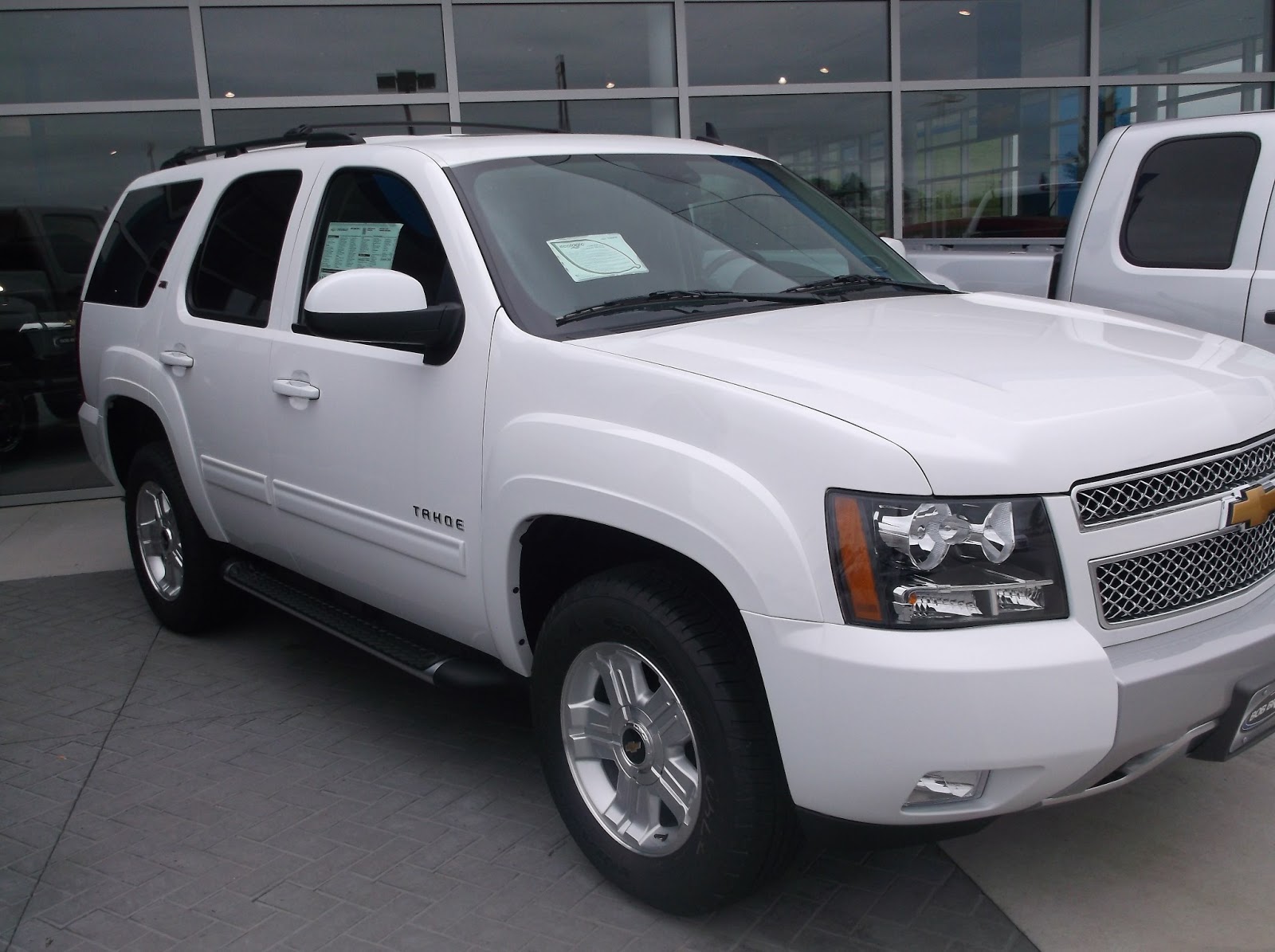
If the base $47,000 Tahoe does not have enough luxury (even with four doors!),
don't fret - this $55,000 model comes with an optional luxury package including heated seats!

 
Monster truck to go...
  I was looking at a $55,000 Silverado Truck that had a base price of $41,000 but was tricked out with a $14,000 package that made it look like a monster truck when Chris the car salesman told me my car was ready but he wasn’t allowed to let me leave until I activated the six month free OnStar feature of my new car. The OnStar is a magic genie or a civil liberty nightmare that can give directions, call for assistance, allow for hands free calling, perform diagnostics, or even unlock my car in case I get locked out (if I had power locks). OnStar knows where you are at all times and I don’t doubt for a second that it can't listen to your conversations and someday it will be able to take video of you while driving. I pushed the little blue ‘O’ button and was greeted by a robotic voice asking me if I wanted to activate my OnStar trial by code or by talking to an attendant. I repeatedly said I wanted to talk to an attendant, Chris repeatedly said I wanted to talk to an attendant, but the automaton voice kept telling us it could not understand our response and repeated the question. After two minutes, the automated voice told us to please wait for an attendant.

  Once I was waiting for an attendant, Chris’s job was done. We said our goodbyes and I headed a few miles away to the Half Price Book Store. About halfway to the bookstore, Brenda the OnStar attendant started talking to me through my car’s speaker system. Brenda took my name and information, activated my account, told me about all the things OnStar could do for me (like call an ambulance in case of an accident), and tried to sell me some OnStar phone minutes. I only had one question for Brenda which was if it took over five minutes to get ahold of someone to activate my account, how long would it take to get ahold of someone in an emergency situation. Brenda proceeded to tell me that the emergency division was much better staffed than the activation division. I felt better hearing that since I don’t know how to swim and while I was waiting for Brenda I had a vision of being swept away in a raging flood and calling OnStar as my tiny car quickly filled with river water only to be told by the friendly automaton voice to please wait for the next available emergency technician and that my call was VERY important to them. Brenda then tried to sell me more phone minutes at which point I arrived at Half-Price Books and bid Brenda and OnStar goodbye.

I can open or close every window in my Spark with my left hand. On the right is a convenient beef stick tray. Both are standard options on the 2013 Chevy Spark without the need to buy an additional luxury package.

  After my side trip to Half-Price books, I headed back home. There was an auxiliary sound jack so I could plug in my amazing iPod and listen to music from my Rhapsody app. The sound in the car was really good and the only problem I had on the ride home was when the car started vibrating like crazy on the highway. After a little trial and error I realized that when I was playing with the power windows I had opened the window on the rear passenger door which caused the intense vibrations. Interestingly enough, my tiny Aveo had the same problem. I closed the window and had a smooth ride home.

  I’m sure people will ask me how I like my car and when they do I’ll tell them what I always say : ‘Ask me in a couple of years’. I will say now that the Kia Rio was the best car I’ve ever owned and will make a dependable backup for any of the other four cars we have. If anyone had ever told me that I would someday own five cars I would have said they were nuts but here I am with five cars. As I got home and parked my white Spark right behind my white Kia Rio and took a picture of both of them, a guy with a truck and a trailer pulled up and asked me ‘How do you like that electric car?’ and when I told him it wasn’t an electric car he said ‘Then why do they call it a Spark? Because it’s so tiny?’

The 2009 Kia Rio (l) and the Chevy Spark. Welcome to Marshalltown, Chevy Spark!
You have a tough act to follow.

Wednesday, May 29, 2013

Playing by the Rules

From the sights to the sounds to the smells,
outdoor chess (even under a covered shelter) is nothing like playing indoors.

  On May 18th I held my first outdoor tournament of the summer. The morning session only had 15 players in attendance (not helped by six no-shows) but everyone had a good time playing and with so few players I was able to talk with the parents and help show the unrated players how they could turn their stalemates into checkmates and develop their pieces towards the middle instead of the edges. If I had to pinpoint a reason for the poor attendance I’d have to say that having six weeks between tournaments gave enough people enough time to get out of the tournament habit but it could also have been a random occurrence.

  Once the morning tournament was over, it was time for my afternoon Time Odds Blitz tournament. I’ve wanted to have a tournament where everyone could play on a more or less equal footing for quite some time and when the outdoor shelter I use was only available until 3pm I decided to have a clock tournament where the higher rated player would have less time than their lower rated opponents and the greater the difference in rating, the less time the higher rated player would have.

  I’ve never held or played in a time odds tournament but having played all comers at the Marshalltown Mall at time odds of one minute to ten the past two years, I knew that one minute was not quite enough time to play a full game of chess against an experienced but lower rated player so I decided to set the minimum amount of time a player could have as two minutes. The tournament was set to take two hours and I wanted to try to get anywhere from five to eight games so I set the maximum amount of time a player could have as eight minutes so if two equally rated players met they would have eight minutes apiece and the longest a game could take would be 16 minutes.

  I had to have the time odds set when I announced the tournament but I didn’t decide on the other tournament rules until a couple of weeks before the actual date. My main considerations were 1) I was going to have a mixture of experienced and beginning players and I wanted them all to have a good time so they would play in future tournaments and 2) I wanted to play in the tournament so I wanted to minimize the number of times that I would be interrupted while playing. Since the tournament was not going to be USCF rated, I had the freedom to have any rules I wanted.

  The most common reason I am called over to resolve a dispute in my youth chess tournaments is when one player claims their opponent touched a piece and the opponent says they didn’t (in USCF tournaments a player must move the piece they touch or take the opponent’s piece they touch). Normally I resolve these problems by saying since I didn’t see the player touch the piece I won’t make them move or take it and closely observe the game from that point on. Since I wouldn’t be able to observe a game AND play I decided on doing away with the touch move rule and instead ending the move when the clock was pressed. This is called ‘clock-move’ and was the unwritten rule in force when I played speed chess for money in New York 30 years ago.

A tournament where everyone can play on equal terms.
Possibly a Quixotic quest but one well worth persuing.

  The most common reason I need to intervene in adult tournaments is when one player makes an illegal move. The penalty for making an illegal move in blitz tournaments is the loss of the game while in longer games the penalty is to add two minutes to the opponent’s time. Neither of these rules was suitable for my tournament. I didn’t want a beginning player (who would no doubt be nervous anyway) to lose a bunch of games because they made an illegal move in the opening. I also didn’t want two beginning players playing each other, making a lot of illegal moves, and then each having 30 minutes to play because of the added time while everyone else just watched. So my penalty for an illegal move was to subtract a minute from the offending player’s time and if they had a minute or less left they’d lose the game.

  There was one problem with this rule. Suppose I had a losing position with 3 minutes left while my opponent had a few seconds left. I could make two or three illegal moves in a row and press the clock. My opponent would lose precious seconds each time they stopped the clock to subtract a minute from my time and may lose the game because of it. If you think that is far-fetched you haven’t seen the depths some will sink to in order to win a chess game. This led me to make an addendum to the time rule that the penalty for an illegal move when the opponent had less than 30 seconds left to be the loss of the game.

  The only other non-standard rule I had was that a checkmate only ended the game if the player had pressed the clock with at least one second left. Normally checkmate ends the game, but I wanted to make sure I wouldn’t be called over after the fact to decide whether the checkmate came before the player’s time ran out or vice versa.

  I had a nice mix of 15 players for the tournament. There were some holdovers from the morning youth tournament, some parents, Mathew Jacob and Eddie Divanovic (who I played against in the Big Money Blitz tournament two years ago), me, and a few other assorted players. I had just paired the first round and was going to post them when I saw a group of people in cowboy hats heading over to the shelter. I immediately recognized them as the chess-playing Carson family including Bethany Carson, the five time Iowa Girls champion and fellow blogger who helps at my chess camp (you can read her account of the tournament here). Also along were Daniel and Sarah Faith who I hadn’t seen in almost three years (and were both taller than me now), Charity (who has beat me in two of our last three encounters in Marshalltown), father Tim (who beat me for the first time ever at our last chess meeting in September of 2012), and mother Betty (who wasn’t going to play). The family was on a day trip to museums in Des Moines and decided to spend a couple of hours playing chess. I repaired the first round, made a quick announcement to make sure everyone understood the rules and we were underway just a few minutes late.

  I had written the time odds on the pairing sheets and had all my clocks set at 8 minutes to 8 minutes, but I still had to set the clocks for each game individually. It only took a few minutes before the first round and even less when one of the players helped me set the clocks before each round. I got interrupted a couple of times when I had to take away a minute from a player who made an illegal move but other than that I was able to concentrate on my games. I played really well in my first two games and torched my opponents (chess parent Jason and Charity Carson) despite having two minutes vs. their eight. In round three it was my turn to have eight minutes against Eddie’s seven. Eddie won a pawn, I gave him another pawn for threats that made him use up some time, and the game boiled down to an opposite colored bishop ending where Eddie had three pawns to my two, but I had three minutes to his 90 seconds. I could have aimlessly moved my bishop around to win on time but instead offered Eddie a draw which he accepted. In the fourth round I played Daniel Carson at six vs. eight minutes. I won a pawn and boiled the game down to a double rook ending, but I remained two minutes behind and couldn’t make any progress. I tried to conjure up some checkmate threats, but Daniel managed a quicker attack and checkmated my king for my first loss of the day. Next I played my third two vs. eight game vs. Justin, an adult first time tournament player. I again won another pawn but got down to less than a minute. I launched a desperate attack which Justin repulsed with a nice tactic and was going to either win a piece or my queen. I went for a cheapo and made a move that threatened checkmate but allowed Justin to take my bishop and remove the mate threat or take my queen. Justin took the Queen and I got the lucky checkmate.

Why didn't I notice that Mathew Jacob and Daniel Carson had played (like in the picture on the left) before the final round? Because I was three feet away concentrating on my battle with top seed Eddie (right). One more example of why directing and playing at the same time is so hard to do. It is impossible to concentrate on my own game AND everything (or anything) else.

  In the last round Daniel Carson and Mathew Jacob were the co-leaders with 4.5 out of 5, but the computer had Daniel playing his dad Tim and Mathew playing me. I changed the pairings to let the co-leaders play each other, BUT since I was so busy playing I didn’t realize that they had already played and drew each other. Having them play each other again for the championship seems logical but it wouldn’t have been fair to the loser of the match since he would have lost out on second place money primarily because of having to play the champion twice. I let the original pairings stand. I played really well against Mathew and had a Knight and three pawns to his Bishop and one pawn when with a 1:17 on the clock I made an illegal move! I had to play by the rules I made, so I took a minute off my clock and just like that I only had 17 seconds left. I didn’t panic and quickly traded off Mathew’s bishop and pawn and stalemated his king with just a few seconds left on my clock for the draw. It was a lucky draw because Mathew could have kept his bishop or pawn to run me out of time and win the game. Because of my draw with Mathew, Daniel won first place and $42 and Mathew second place and $21. Eddie finished third and I was tied for fourth with a couple of other players.

  I had an awesome time playing and everyone seemed to have a lot of fun with the tournament format. There weren’t nearly as many upsets as I thought there would be and almost all of those were scored by tournament winner (Daniel Carson), a rapidly improving scholastic player whose rating hasn’t caught up with her ability (Ana Denison), and a first time tournament player who I gave too low of a rating to (Justin). The younger players generally had trouble giving time odds but also did not take their time when they were getting the odds. The result say the time odds could use a little tweaking, but I disagree. I don’t believe giving the lower rated players more time will help if they don’t use their time and while a higher rated player could conduct a game in 90 seconds, it would make setting the clocks more difficult and two minutes seemed about right since I saw more than a few games where the higher rated players beat their opponent with only a few seconds on their clock.

  If the lower rated players will learn to make use of their time there will be many more upsets in future tournaments. Regardless of how the attendance goes at the future time odds tournaments (I don’t expect the Carson family driving 100 miles for two hours of chess every month!), I think a tournament where the winning chances are somewhat equalized turned out to be a keeper of an idea and one that was well worth trying.

  Speaking of playing by the rules, on May 24th, the Chess Journalists of America posted on their website that the entries for the annual CJA awards are due by June 15th and referred the readers of the post to p.41 of the May 2013 Chess Life Magazine. The magazine gave information on what awards entries are being accepted for, how much the entries cost and the email address of the Awards Chairman in case of any questions. There was also a link to the 2012 awards announcement on the CJA website.

  Aside from the oddity of not having the awards announcement posted on the CJA's own website for nearly a month after being announced in the Chess Life magazine, for the second year in a row there are no guidelines on what should be included with an entry (except that six copies of the Best Book is required) or where they should be sent. Last year I submitted 3 links from Broken Pawn for the best blog award because with no guidelines to follow I went by the 2011 guidelines only to be told four days (and only then after I asked if my entry was received because I had gotten no acknowledgement) before the deadline that the judges were only going to consider one post for the best blog award.

  I would like to submit either of my four part Jackson Open or Okoboji Open posts for the best blog award, but with no guidelines for the submission, I have no idea if blogs will be judged on the submitted posts, the blog as a whole, or last year’s silliness of judging a year-long body of work by a single blog post (I wonder if the entries for the Best Book award will bave only a single chapter or page considered?).

  I’ve submitted entries for the last three CJA awards and was rewarded with the material for many blog posts about the process. My favorite part of the process was to see how my posts compared against the other entries in the voting but last year’s committee did not see fit to release the results of the voting. Last year the awards chairman resigned suddenly in April so it would be marginally understandable not to have any printed guidelines in 2012. With a whole year to prepare there should be no reason to not having the entry rules set before the awards announcement. There isn’t even any address listed for where to send an entry. In my Time Odds Blitz tournament I had the rules listed before the tournament started so everyone could play by them, but the CJA makes it impossible to play by the rules since the rules are unknown.

  When I pointed out the inconsistencies in the awards process last year, an awards committee ‘insider’ found the time to post an ‘anonymous’ comment on my blog to chastise me for criticizing the awards process while whining what a ‘onerous, time consuming, thankless and unpaid responsibility’ being on the committee was. It is telling that while time was found to complain about valid criticisms, there was no time available (with an entire year to prepare) to provide a set of guidelines for the awards submissions, release the results of the prior year’s voting, or even provide an address where the entries should be sent to. Maybe when time is found for these responsibilities to be fulfilled, I will find time to submit an award entry.